Google Ads vs. Facebook Ads: Understanding the Right Choice for Your Business
Online advertising has become an important part of digital marketing. Businesses use paid advertisements to attract new customers, promote their products, generate leads, and increase sales. Google Ads and Facebook Ads are two major platforms that businesses can use for these purposes.
Both platforms provide opportunities to reach potential customers, but they work in different ways. Google Ads can connect businesses with people who are actively searching for products or services, while Facebook Ads can introduce businesses to audiences while they are using social media.
What Are Google Ads?
Google Ads is an advertising platform that allows businesses to promote their products and services across Google’s advertising ecosystem.
One important use of Google Ads is search advertising. When users search for particular products, services, or information, businesses can create campaigns designed to reach people interested in those searches.
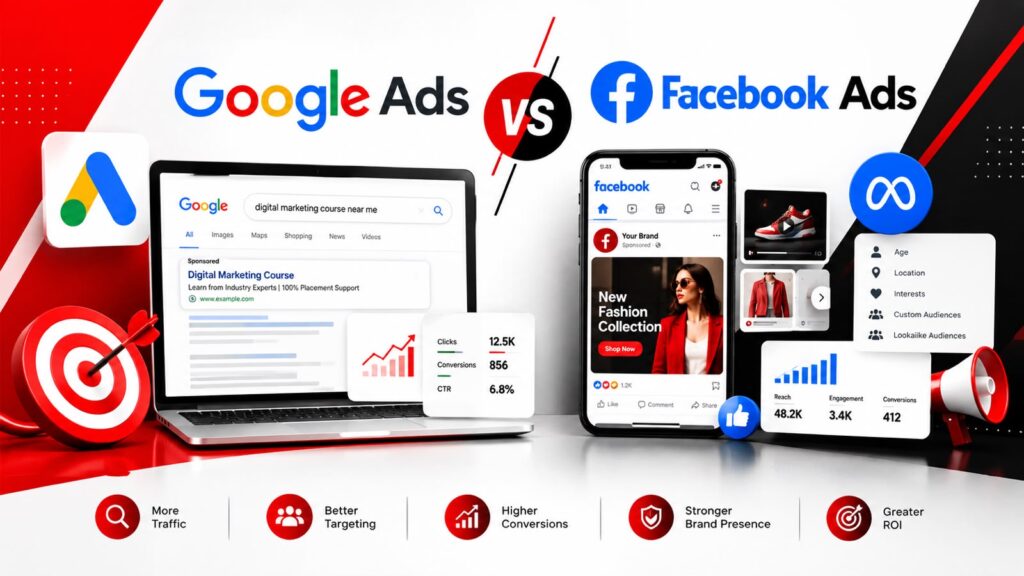
For example, if someone searches for “digital marketing course near me,” a training institute can use Google Ads to promote its course to people looking for similar services.
Google also provides tools that help advertisers measure actions such as conversions and customer activity.
What Are Facebook Ads?
Facebook Ads are part of Meta’s advertising system and can be used to reach audiences across its platforms and supported placements.
Businesses can create advertisements using different creative elements, including images, videos, text, and other formats. Meta’s advertising tools also provide ways to select audiences based on factors such as location, interests, age, and other available signals.
For example, a clothing business could create a visual advertisement showing its latest collection and display it to an audience that may be interested in fashion.
Difference in User Intent
One of the major differences between the two platforms is user behaviour.
People who use Google Search may already have a specific requirement. Someone searching for “best running shoes” may be actively researching or preparing to purchase running shoes.
On Facebook or Instagram, people may see an advertisement while scrolling through social media without actively searching for the product.
Therefore, Google Ads can be useful for reaching existing search demand, while Facebook Ads can help businesses introduce products and services to potential customers who may not have been actively searching for them.
Types of Advertisements
Google and Facebook provide different advertising formats.
Google Ads can be used for search-based campaigns and other advertising placements available through Google’s advertising products.
Facebook and Meta advertising can make strong use of visual content. Advertisers can use images, videos, carousels, and other creative formats to communicate their message.
Choosing an appropriate format depends on the product, target audience, campaign objective, and type of message the business wants to deliver.
Audience Targeting
Audience targeting allows businesses to show advertisements to people who are more relevant to their campaigns.
Google Ads can use search behaviour, audience signals, location, keywords, and other campaign settings depending on the campaign type.
Facebook Ads provides audience tools that can include factors such as age, location, interests, Custom Audiences, and Lookalike Audiences.
For this reason, businesses should define their target customer clearly before creating an advertising campaign.
Budget and Advertising Costs
The cost of online advertising is not the same for every business. Expenses can change depending on the industry, competition, audience, location, campaign objective, and bidding strategy.
Because of these differences, there is no fixed rule that one platform will always cost less than the other.
Instead of looking only at the amount spent, businesses should examine the results produced by that spending.
Important measurements can include:
- Cost per click
- Cost per lead
- Conversion rate
- Cost per acquisition
- Return on advertising spend
- Total conversions
Getting Leads and Customers
Both advertising platforms can contribute to customer acquisition, but they may reach people at different stages of the buying process.
Google Ads can reach people who are already looking for a particular product or service. This can make search advertising useful when customers have a clear need.
Facebook Ads can work earlier in the customer journey by introducing a brand, product, or offer to potential customers. Meta’s advertising ecosystem supports objectives such as traffic, engagement, app installs, conversions, and catalog sales.
The final result will depend on factors such as the advertisement, offer, audience, landing page, and overall campaign strategy.
Increasing Brand Visibility
Social media advertising can help businesses present their brand using attractive visual content. Regular advertisements can introduce products, services, offers, and brand messages to new audiences.
Google Ads can also contribute to visibility by allowing businesses to appear when users search for relevant products, services, or business-related terms.
The role of each platform can therefore be different depending on whether the business is focusing on awareness, consideration, leads, or sales.
Measuring Campaign Performance
Tracking results is an essential part of paid advertising.
Businesses can study several performance indicators, including:
- Impressions
- Clicks
- Reach
- Website traffic
- Leads
- Purchases
- Conversions
- Advertising costs
- Revenue generated
Google provides conversion measurement tools that help advertisers understand customer actions after interacting with advertisements.
Meta also provides advertising and optimization features that allow businesses to examine campaign performance and improve their approach over time.
Using Both Platforms Together
Businesses do not necessarily have to depend on only Google Ads or Facebook Ads.
A company can use Google Ads to capture people who are already searching for its products or services and use Facebook Ads to build awareness and reach additional audiences.
For example, a digital marketing agency could use Google Ads to attract people searching for marketing services while using Facebook and Instagram advertisements to showcase its work, offers, and educational content.
Using both platforms can create a broader digital advertising strategy, provided the business has a suitable budget and can properly measure the results.